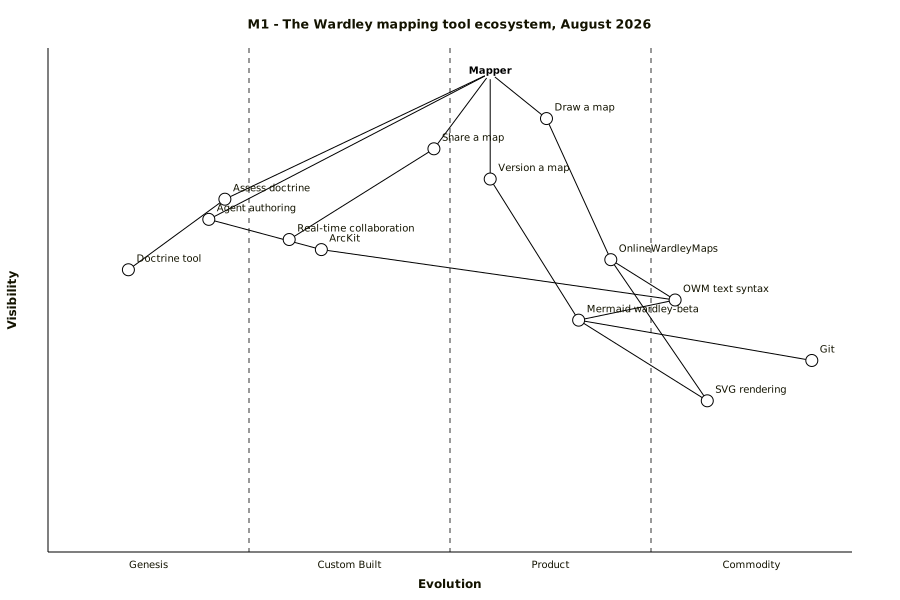
A Wardley map asserts where every component sits on the evolution axis. That makes it arguable — and almost nobody publishes theirs anywhere it can be argued with. This site publishes its maps as source next to the render, its doctrine ratings with the artefact each one rests on, and its resource list with the date every link was last checked. Everything here is meant to be disagreed with in a pull request.
Authoring and versioning are product-to-commodity and in good health. Collaboration, doctrine assessment and agent authoring sit at Genesis with nothing underneath them — those are the holes MapKeep and the doctrine tools left when they died this year. This is a claim, and its source is two clicks away.
A curated link list is not worth building a site for. These are.
40 records across Wardley's six categories and four phases, every rating carrying the artefact it rests on so a reader who disagrees has the evidence in front of them. There is currently no working doctrine assessment tool anywhere in the ecosystem — both are dead and the community index still lists them.
Read the assessment → Never publishedNot a metaphor: three directory trees, three session contracts, three evolution-stage mandates. The agent is told which stage of the evolution axis it is standing on before it does anything. And 31 of the 33 role definitions inside those teams never got the memo, which the page says out loud.
Read the pattern → Verified, not listedMapKeep is dead. MapScript is dead. Every doctrine assessment tool is dead. The Map Camp Slack invite 404s. All of them are still listed as live by awesome-wardley-maps, by Wikipedia, and in two cases by Simon Wardley's own resources page. A page each, with limitations stated and a verification date.
These are the opinionated part. Each one comes out of applying mapping to an agentic software project for six months, each states what evidence would change it, and each is somewhere the standard doctrine gets pushed or contradicted.
| The claim | Why it matters |
|---|---|
| De-commoditisation | A thing can be commoditised at one phase of evolution while still being meaningfully custom-built at the next. The map shows the commodity; it does not show the shield. |
| The custom-axis verdict | You can relabel the evolution axis — air gap → file → API → event-driven — but only sometimes. Relabel the axis when the thing genuinely evolves; use a maturity model when the thing merely improves. |
| You cannot map a gap | A gap has no evolution, so it cannot be positioned. What you get instead is a map shape: the ends are solved, the middle is people. |
| Maps are graphs with position | A map is not a separate artefact from the graph — it is a projection of one. Map queries are graph queries with positional filters. And it has no implementation, which the page says. |
Anybody who spends a lot of money on tokens has an engineering problem. They are using explorer-type code and solutions in a commodity environment.
4 June 2026, and unpublished until now. It is the sharpest thing in the corpus because it turns a strategy framework into an operational cost diagnostic: an invoice becomes evidence of a position on the evolution axis. If your token bill is large, the map is telling you that you are running Genesis-stage machinery over a problem that has a commodity answer. The skill lifecycle it comes from →
Every site in this network publishes a page separating what exists from what is designed. On a mapping site that page has real work to do, because the corpus behind this one over-promises in specific and documentable ways.
Every Mermaid source in the source repository failed, for two mundane reasons — the wrong code fence, and one unquoted note. The eight PNGs from 24 May were the only working visuals in the whole corpus.
Six months stale, against the corpus's own warning that "a map that was accurate three months ago and hasn't been updated is worse than no map."
Maps are graphs with position is architecture. The reality document lists it as PROPOSED. Publishing it as method is honest; publishing it without saying so would not be.
Including the map that has not been drawn yet and should be: the one that shows this project badly. It was asked for explicitly as the test of whether these are analysis or marketing.
Read /shipped/ →/llms.txt and /llms-full.txt are the whole surface, /agents/concepts.json is the definitions endpoint, and /agents/ carries the two things that are easy to get wrong and expensive to get wrong. First: Mermaid and OnlineWardleyMaps coordinates are [visibility, evolution], not [x, y] — transposing them renders without an error and asserts something else entirely. That is proven here by rendering, not repeated from documentation. Second, and it is not a footnote: the evolution axis plausibly encodes consensus rather than objective fact, so a model placing components on it is generating consensus-shaped output with no underlying evidence. An agent must surface its placements as contestable claims requiring challenge, never as findings.