wardley-maps.sgit.ai / Resources / The map cheat sheet, doctrine list, climatic patterns and gameplay
The map cheat sheet, doctrine list, climatic patterns and gameplay
Reference & derivative Dormant reference
What it is
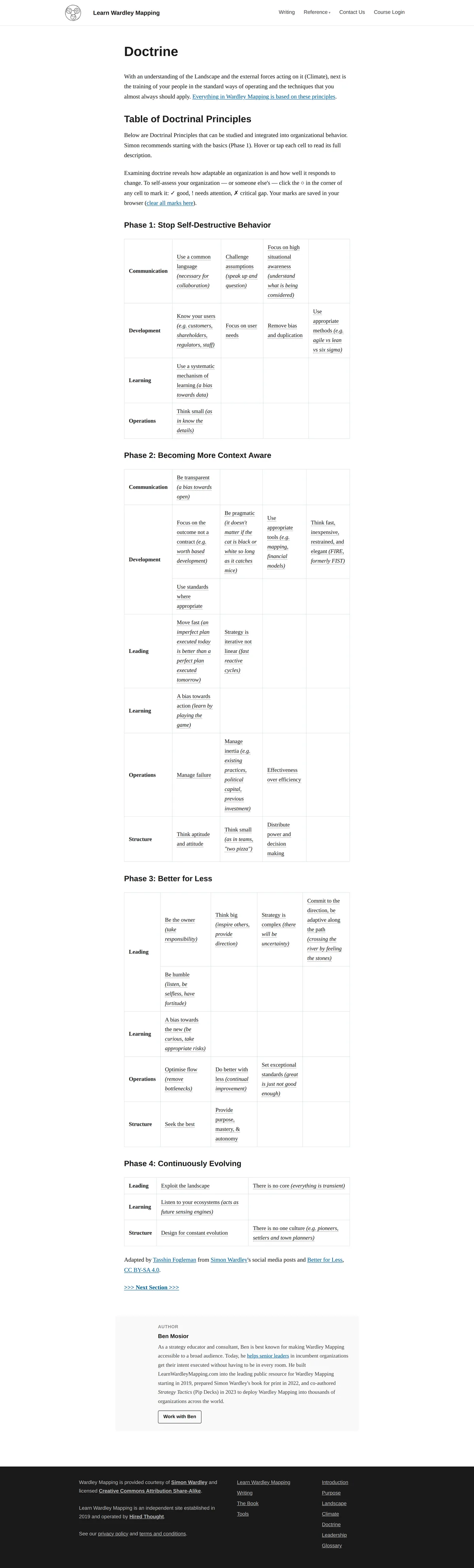
The reference furniture of the technique. The cheat sheet post defines the four constituent parts of any map — anchor (the user need), position (visibility, derived from the chain of needs), types (activities, practices, data, knowledge) and evolution (stages I–IV) — and stresses that evolution is measured by ubiquity vs certainty, explicitly not by time-based diffusion curves, which is the single most commonly misunderstood point in the whole method. It also gives weak signals for each stage. The doctrine post gives the canonical ten: focus on user need; use a common language; be transparent; challenge assumptions; remove duplication and bias; use appropriate methods; think small; think aptitude and attitude; design for constant evolution; enable purpose, autonomy and mastery — defined as "basic universal principles applicable to all industries," distinct from context-specific gameplay and from climatic patterns. Learn Wardley Mapping's grid expands this to roughly 40 principles across four phases: Stop Self-Destructive Behaviour, Becoming More Context Aware, Better for Less, Continuously Evolving.
Limitations
There is no official doctrine poster — I found no canonical printable artefact from Wardley himself. The two doctrine-assessment tools that existed (Chris Daniel's at doctrine.wardleymaps.com, and Justin Stach's Google-Forms-based Doctrine Grid Tool) are both listed as discontinued by Learn Wardley Mapping; doctrine.wardleymaps.com no longer resolves. The 10-item and 40-item doctrine lists coexist without a clear statement of which supersedes which, which confuses newcomers. Climatic patterns and gameplay have no well-maintained standalone list — the book chapters are the only reliable source, and they are long-form prose rather than reference tables. Blog images are low-resolution.
The details
| Maintainer | Simon Wardley (originals); doctrine grid adapted by Tasshin Fogleman for Learn Wardley Mapping. |
|---|---|
| Started | Cheat sheet April 2016; doctrine post 16 August 2016. |
| Status, August 2026 | Wardley's originals are frozen (blog dormant since Feb 2024). The Learn Wardley Mapping doctrine grid is the actively maintained version. There is no single canonical, actively maintained, openly licensed gameplay list — this is a genuine gap in the ecosystem. |
| Licence | ⚠️ Mixed — be careful. Blog originals are CC BY-SA 3.0. Learn Wardley Mapping's doctrine grid is CC BY-SA 4.0. Book chapters are CC BY-SA 4.0. WardleyPedia's climatic patterns page has no stated licence. |
| Home | Cheat sheet — https://blog.gardeviance.org/2016/04/whats-in-wardley-map-and-need-for-cheat.html |
| Best single link | https://learnwardleymapping.com/doctrine/ |
Verified 2026-08-23 — status, licence and links checked against the source on that date. The site re-checks every URL it publishes on a schedule and publishes the run, successes and failures alike.
Attribution. Match the source precisely. Blog material: "Simon Wardley, Bits or pieces?, CC BY-SA 3.0." LWM doctrine grid: "Learn Wardley Mapping, adapted by Tasshin Fogleman from Simon Wardley's posts and Better for Less, CC BY-SA 4.0." Book material: CC BY-SA 4.0. Do not merge these under one notice — 3.0 and 4.0 are different licences.